Learning toys are becoming more than colorful products on a shelf. They can create small, repeatable spaces where children practise sharing, listening, negotiating, and repairing misunderstandings. This matters in China’s growing educational toy market, where parents increasingly seek products with visible developmental value. The LEGO Group’s 2022 Play Well Study collected responses from more than 57,000 people across 30 countries, highlighting the strong connection between play, family interaction, and children’s wellbeing. UNICEF and the LEGO Foundation’s 2018 Learning through Play report also identifies social interaction as a core feature of effective play.
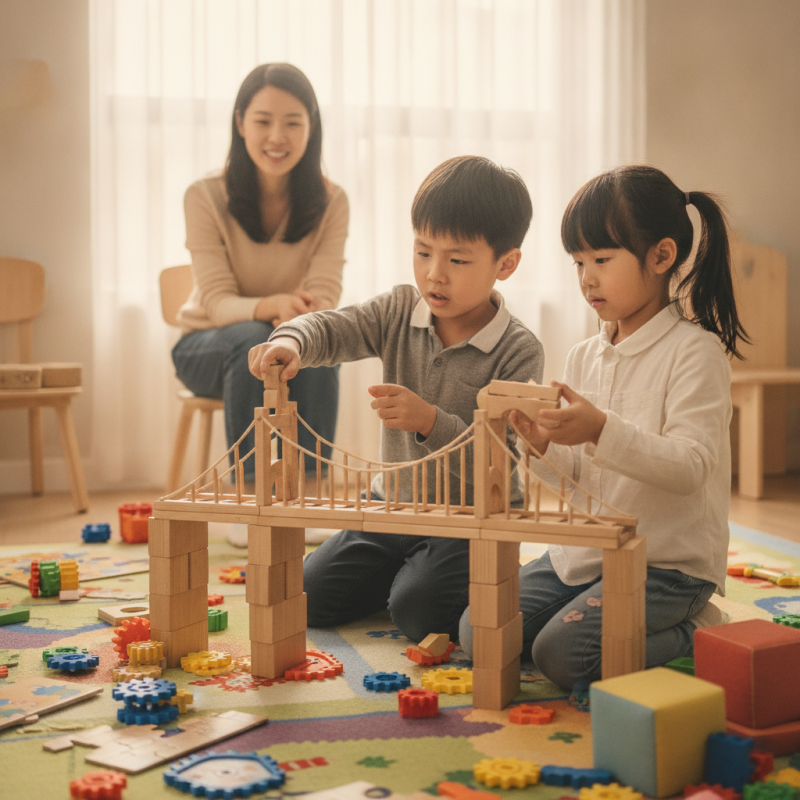
So, how can learning toys improve social skills? The answer often appears during ordinary play. Two children build one bridge, but disagree about its height. A cooperative puzzle encourages them to explain ideas, wait for another turn, and accept a different solution. These moments are simple. They are not always peaceful.
Dr. Kathy Hirsh-Pasek, a leading developmental psychologist, has said, “Play is not the opposite of learning; it is the vehicle of learning.” Her work supports a key principle: toys should invite conversation, imagination, and shared problem-solving, rather than produce passive repetition. However, a toy alone cannot guarantee social growth. Adult guidance, age-appropriate design, and regular peer play still matter. This is where many product claims need closer reflection. A flashing button is not automatically meaningful learning. The strongest toys leave room for children to speak, cooperate, fail, and try again.
What Are Learning Toys and How Do They Support Social Development?
Learning toys are play materials that invite children to explore, make choices, and interact. A set of blocks, for example, can become a shared bridge-building task. Children negotiate where each piece goes, ask for help, and practise waiting for a turn. Pretend-play props can prompt them to assign roles and respond to another child’s ideas. These small exchanges are where social skills become visible.
The American Academy of Pediatrics’ 2018 clinical report describes play as supporting social-emotional development, including cooperation and managing feelings. A 2022 systematic review in Child Development examined 39 studies of guided play. It found modest advantages over direct instruction in early mathematics (effect size 0.24) and task switching (0.40); these are learning measures, not proof of better social skills. That distinction matters. For social development, adults can watch for shared attention, turn-taking, and how children handle disagreement. Offer a simple prompt, such as “How can both figures cross?” Then give children time to solve it together. Not every toy leads to teamwork. Some children need a quieter start, and adult guidance can help—but too much direction may take over the play.
How Learning Toys Encourage Communication and Cooperative Play
A toy can turn a quiet afternoon into a small social challenge. Two children sorting animal figures, for example, must name what they see, listen to each other, and agree where each figure belongs. Cooperative games, building sets, and pretend-play props create natural reasons to ask questions and share ideas.
The LEGO Foundation’s 2018 Learning through Play report outlines five qualities of playful learning: it is joyful, meaningful, actively engaging, iterative, and socially interactive. That last quality matters: children practise taking turns and negotiating while playing, not just talking about those skills.
Adults can help without taking over. Try asking,
“What should we build together?”
Then give children time to decide, even when the plan gets messy. The American Academy of Pediatrics’ 2018 clinical report, The Power of Play, links play with children’s language, executive function, and social-emotional development.
A toy alone cannot guarantee those outcomes. If one child keeps all the pieces, pause and help them find words for a fairer plan. Small disagreements are useful practice, though not every conflict needs an adult solution. Children may need several tries.
How Role-Playing Toys Build Empathy and Emotional Understanding
China Best Toys: How Can Learning Toys Improve Social Skills?
How Role-Playing Toys Build Empathy and Emotional Understanding
Role-playing toys give children a safe place to practice human connection. A toy kitchen can become a café, clinic, or family home. One child may serve pretend soup. Another may ask for help or wait for a turn. These small scenes make social rules visible. They create reasons to listen, negotiate, and repair misunderstandings.
Empathy grows when children act from another person’s viewpoint. A child caring for a stuffed patient might say, “Your arm hurts.” An adult can gently ask, “How could we help her feel safe?” This question links actions with emotions. Early childhood research supports guided pretend play for language, perspective-taking, and emotional awareness. Still, toys alone do not teach empathy. Adult behavior matters greatly. Calm modeling, open questions, and patient turn-taking give play its meaning.
In guided play sessions, educators often observe children changing roles during rescue games. The former doctor becomes the frightened patient, then speaks more softly. The shift may be brief, but meaningful. Not every session works smoothly. Some children control the story, ignore others, or repeat one script. That is useful information, not failure. Adults can add a character, name the conflict, or pause the game. “He looks worried.” “What might happen next?” Small prompts can open a deeper emotional conversation.
China Best Toys: How Can Learning Toys Improve Social Skills?
Role-Playing Toys, Empathy and Emotional Understanding
Role-playing activities can give children opportunities to practice emotional awareness, pretend scenarios, peer interaction and turn-taking.
The chart summarizes selected social-emotional milestones from the U.S. Centers for Disease Control and Prevention (CDC) that are especially relevant to pretend and cooperative play.
These milestones describe typical developmental expectations and do not prove that toys alone cause social-skill improvements.
Source: CDC Developmental Milestones, ages 2–5 years:
cdc.gov/ncbddd/actearly/milestones
How Group-Based Learning Toys Develop Sharing and Problem-Solving Skills
China Best Toys: How Can Learning Toys Improve Social Skills?
Group-based learning toys turn play into a small social laboratory. A child may pass a wooden tile, explain a rule, or wait for a missing piece. These simple actions practice sharing, listening, and emotional control. The OECD Survey on Social and Emotional Skills, covering more than 90,000 students, identifies collaboration as a core skill linked with positive school and life outcomes. Play cannot guarantee these outcomes, but it creates useful daily practice.
A cooperative building set works best when children share one goal, not separate piles of pieces. One child plans a bridge, another tests its balance, and a third suggests a repair. The group must negotiate before the structure can stand. Research reviewed by the LEGO Foundation reports that playful learning supports communication, cooperation, and problem-solving when children remain active participants. In my observation, younger children often grab pieces first. That conflict is not a failure. It becomes a teachable moment when adults ask, “How can everyone contribute?”
The adult’s role matters. Give children time to disagree before offering solutions. Ask open questions, such as, “What could we change?” or “Who has another idea?” A 2023 OECD report also connects stronger social-emotional skills with better student wellbeing, yet toy sessions alone cannot build them. Some children still need quiet roles, visual instructions, or shorter turns. Progress may look small: a child waits five seconds longer, shares a tool, or accepts a failed design. That is meaningful, although imperfect.
How to Choose Learning Toys for Different Social Skill Levels
China Best Toys: How Can Learning Toys Improve Social Skills?
Choosing learning toys should match a child’s current social skill level, not only their age. In hands-on play sessions, I have seen shy children engage more easily with simple matching games. These toys create a shared focus without demanding immediate conversation. For beginners, choose puzzles, turn-taking games, stacking tasks, or toys with clear visual steps. Keep the group small. Two children may feel safer than five.
Children with developing social skills can manage toys requiring simple rules and shared decisions. Cooperative board games, pretend-play sets, and building materials encourage asking, listening, and sharing roles. Watch for practical details. Can the toy support two or more players? Are the rules flexible enough for a child who becomes frustrated? A short game often works better than an impressive, complicated one. I once expected a detailed role-play activity to encourage conversation, but the children focused only on arranging the pieces.
Children with stronger social skills may benefit from strategy games, team challenges, and open-ended construction tasks. These activities can practice negotiation, patience, perspective-taking, and graceful responses to losing. Adults should observe without controlling every move. Offer prompts such as, “What could your partner choose?” or “How can you change the plan?” Avoid forcing eye contact or instant sharing. Progress is uneven, and some children need repeated practice. A carefully chosen toy supports interaction, but patient guidance and real playtime matter more.
FAQS
Learning toys invite children to explore, choose, communicate, and interact. Blocks, sorting figures, games, and pretend-play props are common examples.
Two children might build one bridge together. They decide where each block goes, request help, and practise waiting for turns.
Sorting animal figures creates reasons to name objects, listen, ask questions, and agree on locations. The conversation may be messy.
Yes, pretend play lets children act from another person’s viewpoint. A child caring for a stuffed patient may notice fear or pain.
Try asking, “How can both figures cross?” Then wait quietly. Too many instructions can take control away from children.
No. A toy alone cannot guarantee empathy, sharing, or cooperation. Adult behavior, patient turn-taking, and repeated practice also matter.
Pause when one child keeps every piece. Ask, “What would make this plan fair?” Small conflicts can build skills, but adults need not solve everything.
Offer a quieter starting point, such as sorting three figures together. Some children need time before joining others. That is not necessarily failure.
A child playing a doctor may become the frightened patient. This change can encourage softer speech and greater attention to another viewpoint.
Notice what happened without blaming the child. A repeated script, ignored partner, or controlled story shows where support may help. We may misread it.
Conclusion
Learning toys are designed to make learning active, enjoyable, and meaningful through play. They can support children’s social development by encouraging communication, cooperation, and shared attention. Games and building activities teach children to listen, express ideas, take turns, follow simple rules, and work toward a common goal. In this way, how can learning toys improve social skills becomes clear: they create safe opportunities for children to interact, solve challenges together, and practice positive behavior.
Role-playing toys also help children understand different perspectives by allowing them to act out everyday situations and recognize emotions. Group-based activities strengthen sharing, negotiation, problem-solving, and patience, while helping children manage disagreements constructively. When choosing learning toys, adults should consider each child’s age, interests, confidence, and current social abilities. Simple cooperative toys may suit beginners, while more complex games can challenge children who are ready to communicate, lead, compromise, and collaborate with others.

 Osfor Toy
