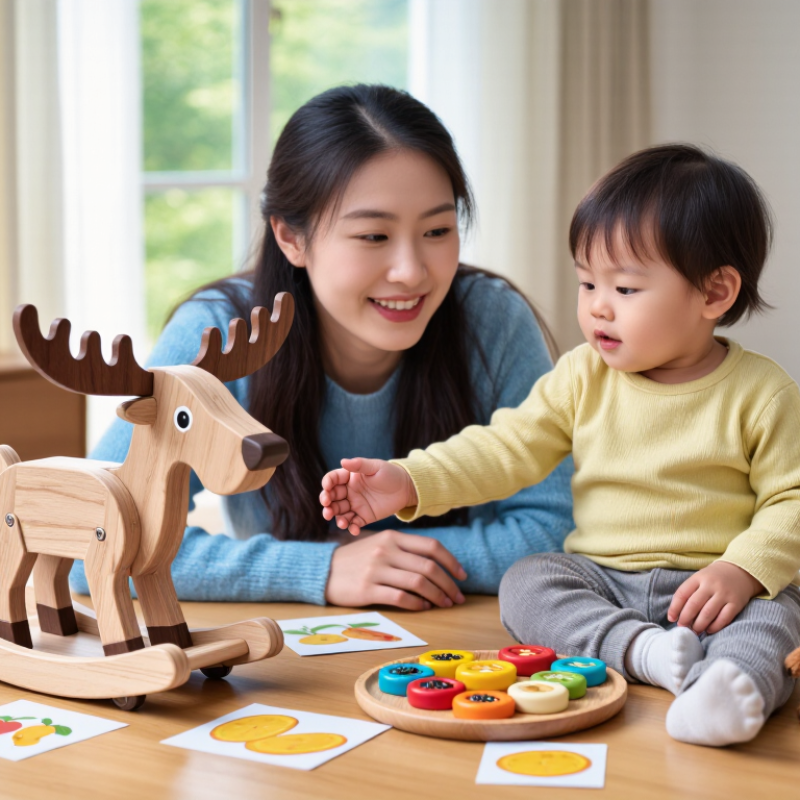
In 2026, parents searching “what educational toys help with language development” will find no shortage of talking gadgets, picture cards, and pretend-play sets. But the most useful toy may be a simple wooden animal beside a curious child. A toy creates an opportunity; a responsive adult helps turn that moment into conversation. Name the animal, pause, and let the child reach for a word. Small exchanges matter.
Dr. Patricia Kuhl, a language and brain-development researcher at the University of Washington, has said, “Babies are born citizens of the world.” Her research highlights how early exposure to speech helps infants notice language sounds. That does not mean a toy can teach language on its own. A recorded voice may capture attention, but it cannot always follow a child’s gaze or wait through a thoughtful pause.
Look for toys that invite back-and-forth play: picture books with clear images, puppets for simple dialogues, and pretend food for naming and describing. Keep the play concrete. “The red cup is full” gives a child more to explore than a flashing button. Yet even good toys can miss the mark if they are too noisy, complicated, or disconnected from a child’s interests. There is no perfect shopping list. This guide examines what educational toys help with language development, what evidence can—and cannot—tell us, and how everyday play can make room for real words.
What Language Development Skills Should Educational Toys Support in 2026?
In 2026, educational toys should support more than vocabulary memorization. They should encourage turn-taking, listening, gesture, storytelling, and flexible conversation. The CDC’s 2022 developmental milestones state that most two-year-olds say at least two words together, such as “more milk.” Toys can make this practice natural: a pretend kitchen encourages requests, while picture cards invite children to describe colors, actions, and feelings. Small details matter.
The National Early Literacy Panel found that oral-language skills, phonological awareness, and alphabet knowledge strongly support later reading development. Therefore, well-designed toys should include rhyming, sound matching, syllable clapping, and open-ended story prompts. They should not demand one correct answer. A child might turn a toy animal into a doctor, a monster, or a lost friend. That unexpected use is valuable.
Responsive interaction remains essential. UNICEF’s Care for Child Development guidance emphasizes play and communication between caregivers and children, not isolated screen exposure. Adults can pause, repeat a child’s words, and expand them: “Dog runs” becomes “The small dog runs quickly.” I have found this simple technique more useful than constant correction. Still, toy claims deserve scrutiny. A colorful package cannot prove language gains. Progress should be observed through longer conversations, clearer sounds, richer descriptions, and greater confidence over time. Some children need more support. Dawdling is not failure.
What Educational Toys Help Language Development in 2026?
Language Development Skills Educational Toys Should Support
Educational toys should provide repeated, interactive opportunities for children to practice expressive language, receptive language, social communication, speech sounds, and early narrative skills. The chart shows broad developmental windows rather than fixed targets, because children develop language at different rates.
Developmental references: American Speech-Language-Hearing Association, “Communication Milestones”; Centers for Disease Control and Prevention, “Developmental Milestones.” Age ranges are approximate and are not intended for diagnosis.
Which Types of Educational Toys Build Vocabulary and Communication?
Which Types of Educational Toys Build Vocabulary and Communication?
Open-ended toys give children reasons to name, describe, and negotiate. Building blocks invite words such as tall, shorter, under, and balance. A caregiver can ask, “Where should this piece go?” Then pause. That quiet moment gives a child room to answer, point, or try a new word. Pretend-play sets, like a toy kitchen or small animal figures, support everyday phrases: “Pour the tea,” or “The bear is hungry.” Familiar scenes can make conversation feel less like a lesson.
Picture cards, matching games, and simple puzzles can strengthen naming and listening. A child might sort objects by color, describe a picture, or follow a two-step direction. Keep the language close to the child’s level, then add one useful word: “A dog—yes, a spotted dog.” Repeating a favorite game is not a problem. It can help new words stick.
Books with movable parts and puppets also encourage back-and-forth talk. Ask what a character might do next, and accept short answers. Even a gesture can start a conversation. Not every toy sparks speech, and some children prefer watching before joining in. That can feel slow. Follow the child’s interest, model clear language, and leave space for their response; the interaction matters more than the toy itself.
How Do Interactive Toys Encourage Listening and Speaking Skills?
Interactive toys can turn listening into an active habit. A child presses a button, hears a question, and chooses how to respond. A talking animal, for example, might ask, “What sound does a sheep make?” The child listens, pauses, then answers aloud or selects a matching picture. That small pause matters. It gives children time to process words before speaking.
The best toys leave room for real conversation. Look for clear speech, gentle sound levels, and prompts that invite more than one answer. A toy that asks, “What do you see?” can encourage a child to name colors, describe a toy car, or tell a short story. Grown-ups can build on those replies: “You said red. Where else do you see red?” This back-and-forth models new words without turning play into a test. Keep the pace relaxed. Silence is useful, too.
Not every child responds to a toy in the same way. Some will repeat the toy’s words; others may prefer pointing before speaking. Both can be steps toward communication. Pay attention to whether the child stays engaged, understands the prompts, and begins using words during everyday play. If the toy talks too quickly, or gives praise after every button press, it may distract more than it helps. I’d change my choice if the child seems to be listening only for the next sound. Children need people, not just prompts, to practice conversation.
What Age-Appropriate Toys Support Language Learning at Each Stage?
For babies, choose soft books, textured cloth pages, and simple toys that invite naming. Point to a picture, pause, and respond to a coo or reach. Keep it face-to-face. The toy is only a prompt; your voice and attention do the teaching.
From about one to three years, offer stacking cups, pretend food, animal figures, and chunky puzzles. Model short phrases such as “big cup” or “dog is sleeping,” then let the child take a turn.
A 2020 systematic review in Child Development found shared picture-book reading interventions were associated with gains in children’s expressive language (g = 0.41) and receptive language (g = 0.26). These are average study effects, not guarantees for every child.
Preschoolers benefit from puppets, picture-sequence cards, dress-up props, and cooperative games that encourage storytelling and conversation. Ask open questions, but accept gestures or brief answers; pressure can shut down a chat.
For early school-age children, word games, beginner board games, and build-and-describe kits support vocabulary, explanations, and turn-taking. Choose materials that match the child’s interests and current abilities, not just their age label.
Some toys will fall flat. That is useful feedback: simplify the task, join the play, or try again later.
How Can Parents Choose Safe and Effective Language Development Toys?
Choosing a language toy starts with the child, not the packaging. Look for clear words, familiar objects, and prompts that invite a response. A toy that pauses for a child to name a red cup or animal gives conversation room. Simple is often enough. Parents can model a word, wait, then respond to the child’s sounds or gestures. That back-and-forth matters more than a toy’s number of buttons.
Check the age guidance and inspect parts, seams, cords, and battery compartments before play. Avoid toys with loose pieces that could fit in a young child’s mouth. Choose sturdy materials with smooth edges, and check whether surfaces can be wiped clean. For electronic toys, test the volume beside the child; loud sounds can make conversation harder. Read the words and stories yourself, too. Are they understandable, respectful, and useful in everyday life? A toy may promise vocabulary gains, but no product can replace a responsive adult. Honestly, some “educational” toys are busy and frustrating. Notice whether your child returns to play, or simply walks away.
FAQS
They should encourage listening, turn-taking, gestures, storytelling, and flexible conversation. Vocabulary matters, but it is not everything.
A toy kitchen can invite requests like “more soup.” Animal figures can inspire short stories and playful descriptions.
Repeat the child’s words and gently add detail. “Dog runs” might become “The small dog runs quickly.” Keep it natural.
Try soft books, textured cloth pages, and simple toys. Point to a picture, pause, and respond to a coo or reach.
Stacking cups, pretend food, animal figures, and chunky puzzles offer chances to name objects. Model short phrases, then wait.
Shared reading can help children express and understand language. Study results describe average effects, not guaranteed progress for every child.
Puppets, picture-sequence cards, dress-up props, and cooperative games can prompt stories. Accept gestures or brief answers, too.
Match toys to the child’s interests and current abilities, not only the age label. Some toys fall flat. That is useful feedback.
No. Watch for longer conversations, clearer sounds, richer descriptions, and growing confidence over time. Progress can be uneven.
Conclusion
In 2026, educational toys can support language development by giving children engaging ways to hear, understand, and use words. What educational toys help with language development? Look for options that encourage storytelling, naming, asking questions, turn-taking, and conversation. Picture cards, pretend-play sets, books with interactive prompts, and simple word games can help build vocabulary while giving children opportunities to express ideas. Toys that invite children to describe what they see or invent a story can strengthen both communication and creative thinking.
Interactive toys can also develop listening and speaking skills when they respond to a child’s choices, encourage repetition, or prompt a spoken answer. The best choices change with age: babies benefit from songs, sounds, and shared picture books; toddlers enjoy naming and sorting activities; preschoolers can explore pretend play and simple stories; and older children may enjoy word puzzles and more complex storytelling games. Parents should choose age-appropriate toys made from durable, safe materials, with clear instructions and engaging activities that encourage real interaction rather than replacing conversation with a caregiver.

 Osfor Toy
